
|
It is currently February 4th, 2012, 2:28 am
|
 |
|
 |
|
| Shock Your Pool |
|
Shock Your Pool
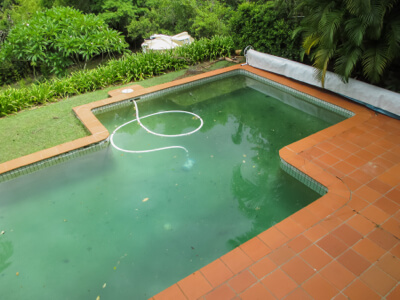
Shocking the pool will eliminate algae, combined chlorine (CC), and any other organic contamination. If you have algae, or the CC level is above 0.5, or the free chlorine (FC) level is zero, you should shock the pool. Many people also like to shock the pool when the FC level falls significantly, as it often does after a major storm or large swim party. This is done even if FC doesn't get all the way to zero, just to be sure everything is all right. If you are maintaining proper FC levels there is no need to shock weekly, or on any other regular schedule.
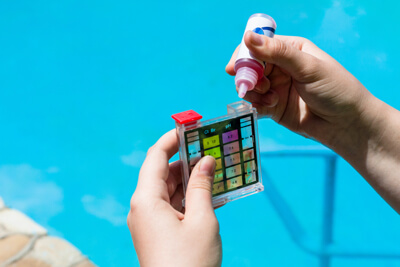
To shock, it is a huge help to have a FAS-DPD chlorine test. You also need to know your current CYA level, and then look up the corresponding FC shock level. You can use the The Chlorine/CYA Chart at Pool School to find the correct FC shock level for your CYA level. It is best to use bleach or liquid chlorine when shocking.
Shocking:- Measure the FC level
- Add enough chlorine to bring FC up to shock level (or a little higher)
- Repeat steps 1 and 2 as frequently as practical, but not more than once per hour, and not less than twice a day, until:
- CC is 0.5 or lower;
- An overnight FC loss test shows a loss of 1.0 ppm or less;
- And the water is clear.
- Brush the entire pool once a day
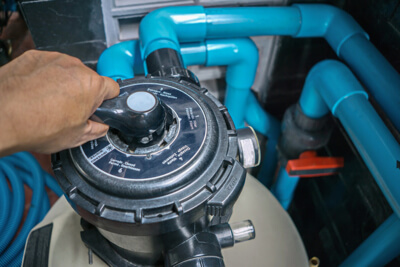
- Backwash or clean the filter as needed
Depending on what kind of filter you have, it can take the filter a week or more to completely clear up the water, even after all of the algae is dead. DE filters are usually much faster than that, but require frequent attention when cleaning up algae. Sand filters are the slowest, and cartridge filters are somewhere in-between.
While shocking, the appearance of the water should improve each day, though perhaps only by a little. If you fail to see any improvement you might have a problem with your filter, or have a higher CYA level than you think, or bad circulation, or have some other more complex problem.
The goal of shocking is to add enough chlorine to oxidize all of the algae, combined chlorine, bacteria, viruses, ammonia, and other organic contaminates. Oxidization breaks down the organic molecules into smaller parts which are harmless. When shocking, you need to keep adding chlorine until the breakdown process is complete.
Higher FC levels will oxidize contaminates more quickly, but levels that are too high can cause damage to the pool or the pool equipment. Recommended shock levels are designed to break down contaminates reasonably quickly while posing minimal risk to the pool. It is impossible to know in advance just how much chlorine will be required to shock the pool. Instead, chlorine is added to maintain shock level until testing shows that the process is complete.
If you have a salt water chlorine generator, chlorine tablet dispenser, or Liquidator, you will still need to use another chlorine source for shocking. All of these devices are designed to add chlorine slowly and steadily over many hours. To kill algae or lower CC, you need to put in lots of chlorine all at once. The SWG, tablet dispenser, or Liquidator can be very helpful in the follow up stages to maintain FC at shock level, but for the initial couple of chlorine applications, you need to use another chlorine source.
© TroubleFreePool.com 2012
|
|
|
 |
|
 |
|